
Green Driving: how drivers' driving style affects fuel consumption, costs and CO₂ emissions
2026-08-05
Green Driving: how drivers' driving style affects fuel consumption, costs and CO₂ emissions
Two drivers, the same vehicle, a similar route – and yet the resulting fuel consumption and wear on the vehicle can be quite different. Often the difference lies not in the vehicle, but in how the driver uses it.
Driving style has a bigger influence on the running of a company vehicle than it may seem at first glance. If a driver drives more aggressively than necessary or uneconomically, it gradually shows up in fuel consumption, vehicle wear, safety and the amount of emissions produced.
This is exactly where Green Driving – the driver's driving style rating – comes in.
What is a driving style rating and how does it work?
Modern GPS vehicle tracking has long been about more than showing a vehicle on a map. The GPS tracker in the vehicle can also record driving events that reveal how the driver behaves behind the wheel.
You can monitor, for example:
- harsh acceleration and braking,
- sharp cornering,
- exceeding the set speed limit,
- prolonged engine idling.
The data is then evaluated, giving the company an overview of how individual drivers treat their vehicles. With the driving style rating, individual drivers' results can be compared and their development tracked over time.
So the question is no longer just “Where are our vehicles going?” but also “How are they being driven?”
The same vehicle doesn't mean the same fuel consumption
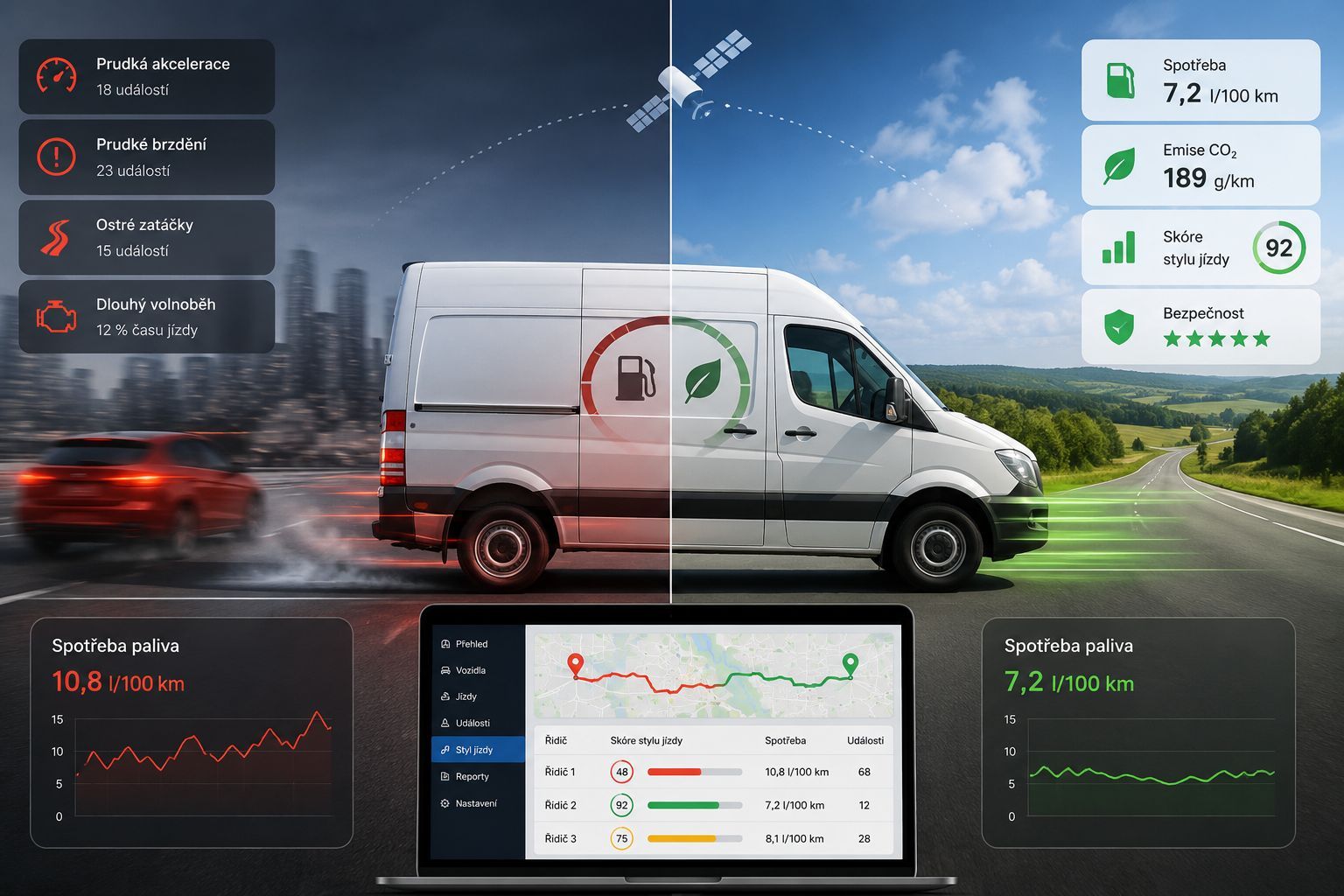
Imagine two identical company vans. One driver accelerates smoothly, anticipates what's ahead and keeps unnecessary idling to a minimum. The other often accelerates hard, brakes at the last moment and leaves the engine running even during longer stops.
By the end of the month, both vans may have covered a similar number of kilometres. Their fuel consumption and operating costs, however, may not be the same.
With fuel consumption analysis, a company can compare individual vehicles and look for the causes of inefficient operation.
Instead of a vague feeling that “some of our vehicles are just too thirsty”, it gets specific data it can work with.
Less fuel, less CO₂ and less wear and tear
The environmental and the financial side of running vehicles are closely linked. For combustion-engine vehicles, a simple principle applies: the less fuel you use unnecessarily, the less CO₂ your vehicles emit in operation.
What's more, a smoother driving style doesn't only save fuel. Fewer harsh manoeuvres also mean less strain on the brakes, tyres, suspension and other parts of the vehicle.
For a single vehicle, the difference may not be significant. But for a company running dozens of vehicles, even small savings are multiplied by the number of vehicles and kilometres driven.
That is exactly why fleet management doesn't just track where vehicles are, but also helps you work with data on your fleet's costs, fuel consumption and operation.
Rating drivers isn't about punishment
Monitoring driving style shouldn't be used as a tool for finding someone to blame. It is far more valuable as feedback and a basis for improvement.
A single instance of harsh braking may be a reaction to an unexpected situation. But if similar events keep recurring with the same driver, that is a trend worth paying attention to.
The data can be used in driver training, to track subsequent improvement or, conversely, to reward those who consistently drive safely and economically. With events and alerts, you can also monitor things such as exceeding the set speed limit.
From gut feeling to hard data
“This van's fuel consumption seems awfully high.”
“The tyres on this vehicle have worn out early again.”
“This driver probably pushes the vehicle harder than necessary.”
Without data, these are mostly just assumptions. A driving style rating lets you assess situations like these on the basis of how the vehicles are actually driven.
Combined with vehicle movement history, the electronic trip journal and other fleet management features, it gives the company a more complete picture of how its vehicles are actually being used.
How hard is it to introduce driving style monitoring?
In most cases, not very. Depending on the type of vehicle and the features you need, the GPS tracker can be connected via the OBD connector, for example, or directly to the vehicle's battery.
The collected data is transferred automatically to the system, where it can be evaluated alongside other information about your fleet. A basic overview of your vehicles is also available through the mobile app.
So the driving style rating is not just a “green” feature of a GPS system. It is a practical way to use real data to cut fuel consumption, go easier on your vehicles, encourage safer driving and reduce CO₂ output at the same time.
Try the driving style rating on your own vehicles
Nothing beats seeing the results in your own data. That's why our GPS vehicle tracking is yours to try free for 30 days with no obligation, so you can find out what the data on your vehicles' operation and your drivers' driving style really shows.
Join 30,000+ satisfied customers and save money with GPS vehicle tracking.
Or write to: obchod@satelitnisledovani.cz
Have a question or want a free, no-obligation quote?


