
How much can you save with GPS vehicle tracking: the figures behind the savings
2026-11-10
“GPS tracking will save you up to 50% of your costs.” You'll find figures like this on many suppliers' websites, usually with no explanation of where they come from. We'll do it differently: we'll show which items the savings are made of, what ranges are typical in the industry, and work through a model example for a company with ten vehicles. You can then recalculate the figures for your own fleet.
Where the savings come from
GPS tracking on its own saves nothing. The savings come from what you do with the data. For company vehicles, there are four main areas.
1. Fuel: typically 10–15%
The biggest item. The savings come from three sources: fewer unnecessary kilometres thanks to route optimisation, smoother driving thanks to driving style rating, and less private use and idling. Fuel consumption monitoring shows you where the fuel goes. The 10–15% range matches industry case studies. Higher figures tend to be the exception, in fleets that previously had no oversight at all.
2. Kilometres driven: 15–20% in delivery and field service
Companies that plan dozens of stops a day typically save 15–20% of kilometres through route planning and digital dispatching. Most of this saving shows up in the fuel figure above, so we don't count it twice in the model calculation. Read more in How to optimise routes in your delivery business.
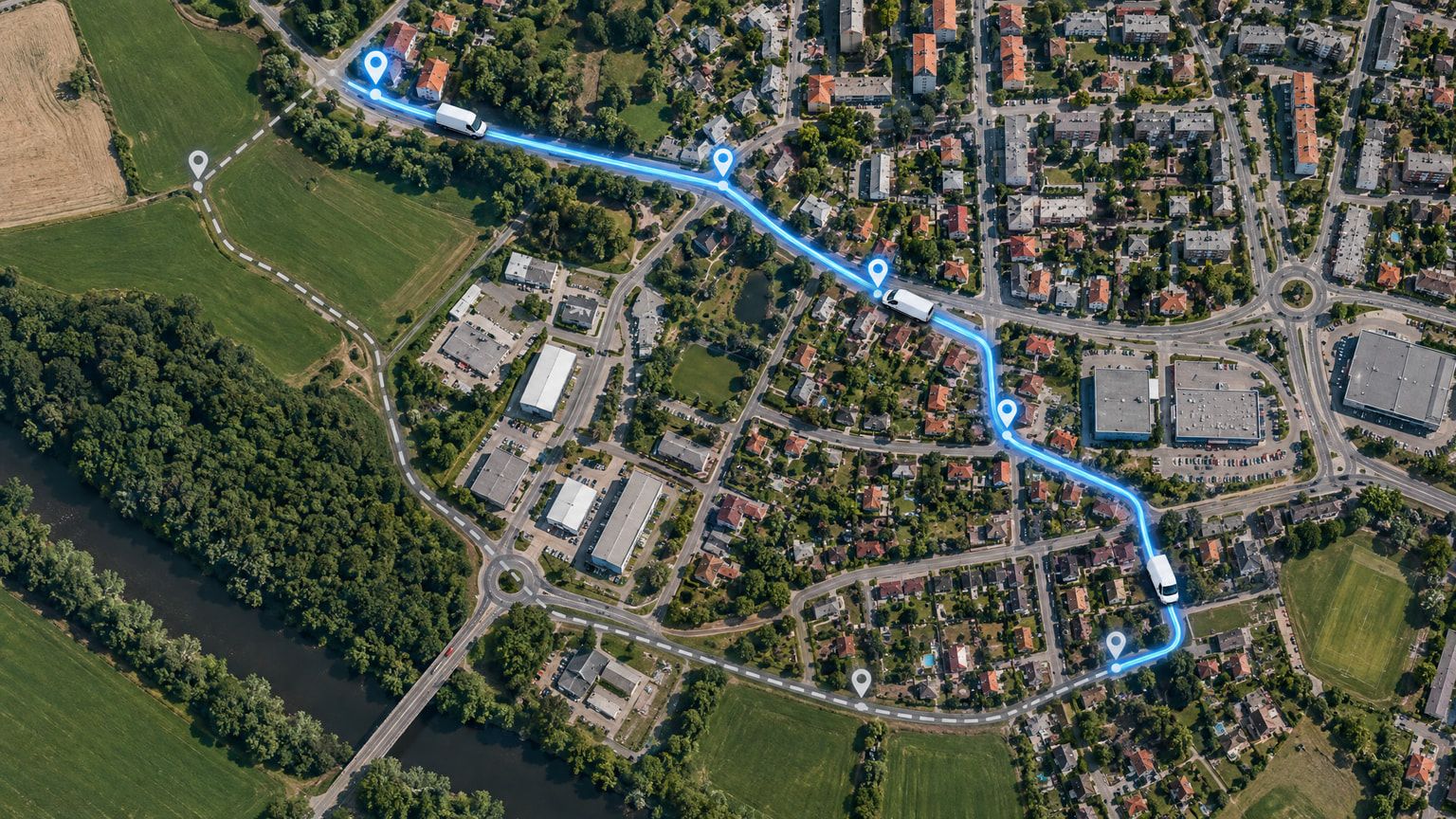
Illustration: optimised route (blue) versus an unnecessary detour (grey).
3. Administration: up to 30% of the time
Filling in the trip log by hand, working out who was where and when, and putting together paperwork for the accountant. The electronic trip journal records trips automatically and reports are sent on their own. Time savings on administration are commonly up to around 30%.
4. Insurance and damage: up to 15%
Fewer accidents and a documented driving style are a strong argument when negotiating with your insurer. Telematics discounts in the industry are typically around 5–15% and depend on the insurer, so we leave them out of the model calculation.
Model calculation: 10 company vehicles
As an illustration, we take a company with 10 cars or vans. Replace the assumptions with your own figures.
- each vehicle drives 30,000 km a year,
- average consumption of 6 l/100 km,
- diesel price of €1.95/l as of 1 November 2026 (CZK 47.51/l, converted at the Czech National Bank rate of CZK 24.36/€ of 30 October 2026),
- a manual trip log takes 10 minutes a week per vehicle.
Fuel: 10 vehicles × 1,800 l × €1.95 (price as of 1 November 2026) = roughly €35,100 a year. A 10–15% saving means approximately €3,500–5,300 a year.
Administration: 10 minutes a week × 52 weeks × 10 vehicles = roughly 87 hours a year that nobody has to spend copying out trips.
GPS tracking costs: the Basic plan starts at €6.00 a month per vehicle, i.e. from €720 a year for 10 vehicles. We'll quote the device and installation based on your vehicle types; details are in the pricing.
In this example, the fuel savings alone cover the subscription several times over. Upfront costs are usually recouped within 6 to 12 months, and sooner in larger fleets with higher mileage.
This is a model calculation, not a guarantee. Actual savings depend on how the company has run its vehicles so far and how it will work with the data.
Savings on the tracking itself: Rohlik Group
Besides vehicle running costs, you can also save on what you pay for tracking. Rohlik Group previously used a different monitoring solution plus separate sensors for measuring the temperature in the cargo space. We replaced both with a single system, and Rohlik saved 77% of its original costs for vehicle monitoring and cold chain monitoring.
Note that this is a saving on the price of the solution itself, not on fuel or vehicle running costs. Those are calculated separately, as the model calculation above shows. Read the full story in the Rohlik Group reference.
How to find out how much you'll save
- Measure your starting point. How many kilometres and litres your vehicles use each month, and how much time administration takes.
- Try tracking on part of your fleet. You can try our GPS device free for 30 days with no obligation.
- Compare the data. After a month you'll see where vehicles drive unnecessarily, who drives uneconomically and how much time the trip log takes. Cost overview shows you the result in money.
We'll be happy to go through the calculation with your own figures. For larger fleets, we'll propose a solution as part of fleet management.
Join 30,000+ satisfied customers and save money with GPS vehicle tracking.
Or write to: sales@sensfleet.com