
Mandatory tachographs for vans from 1 July 2026: who is affected and how to comply
2026-07-03
Mandatory tachographs for vans from 1 July 2026: who is affected and how to comply
Since 1 July 2026, new rules apply to light commercial vehicles in international transport. If you operate vans over 2.5 tonnes and drive them across borders, they must be fitted with a smart tachograph version 2, and drivers must follow the same driving and rest time rules as truck drivers. Here is who is affected, who is exempt, which deadlines apply and how GPS vehicle tracking and fleet management help you comply.
Who the new rules apply to
From 1 July 2026, EU Regulation 561/2006, as amended by Regulation 2020/1054, covers vehicles with a maximum permissible mass, including trailer, of more than 2.5 tonnes when they carry goods in international transport or cabotage. Vehicles over 3.5 tonnes were already covered.
Purely domestic transport is not covered by this part of the regulation.
Who is exempt
- Own-account transport: vehicles between 2.5 and 3.5 tonnes that do not carry goods for hire or reward but for the company's or driver's own needs, where driving is not the driver's main activity (Article 3(ha)).
- Craftsman exemption: vehicles up to 7.5 tonnes carrying materials, equipment or machinery the driver needs for their work, within 100 km of the base, where driving is not the driver's main activity (Article 3(aa)).
If you are not sure whether an exemption applies, check with your national enforcement authority or ask us.
What van operators must do
Smart tachograph version 2
Vans covered by the rules must be fitted with a smart tachograph version 2 (G2V2). It records the vehicle's position automatically when crossing a border, when loading and unloading, and at regular intervals while driving.
Driving and rest times
- daily driving time up to 9 hours, twice a week up to 10 hours,
- up to 56 hours a week and 90 hours in any two consecutive weeks,
- a break of at least 45 minutes after 4.5 hours of driving,
- daily rest of 11 hours, reduced to at least 9 hours,
- weekly rest of 45 hours, in some weeks reduced to at least 24 hours.
Downloading and storing data
Driver card data must be downloaded at least every 28 days and vehicle unit data every 90 days (Regulation 581/2010). At a roadside check, the driver must show records for the current day and the previous 56 days.
Penalties
Penalties are set by each EU country and can be significant for the operator and the driver. In the Czech Republic, for example, operators face fines of up to CZK 500,000 for failing to keep records and up to CZK 350,000 for breaching driving times or missing download deadlines. DSRC technology also lets enforcement officers read tachograph data without stopping the vehicle.
How to comply without paperwork
Remote tachograph download
With the SensFleet tachograph service, data from the tachograph and driver cards is downloaded remotely at regular intervals. You do not need to bring vehicles back to base just for paperwork, and you will not miss the 28-day and 90-day deadlines. Downloaded DDD files are stored in the archive in the app, and you can upload older files manually.
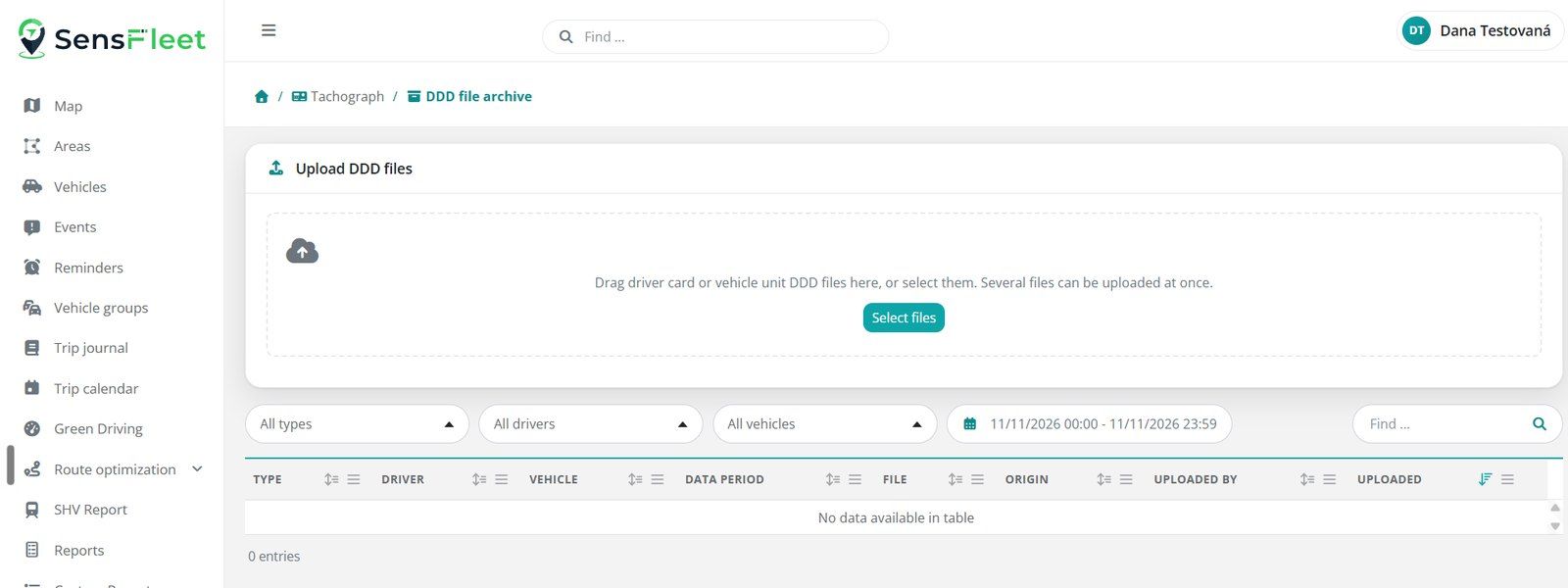
Archive of DDD files from tachographs and driver cards. Illustrative data.
Real-time driver overview
The app shows each driver's current tachograph activity (driving, work, rest) right next to the vehicle on the map. For every driver you see how much time is left until the next break and daily rest, a timeline of the day, and weekly and fortnightly limits. Dispatchers can plan trips without drivers having to break the rules.
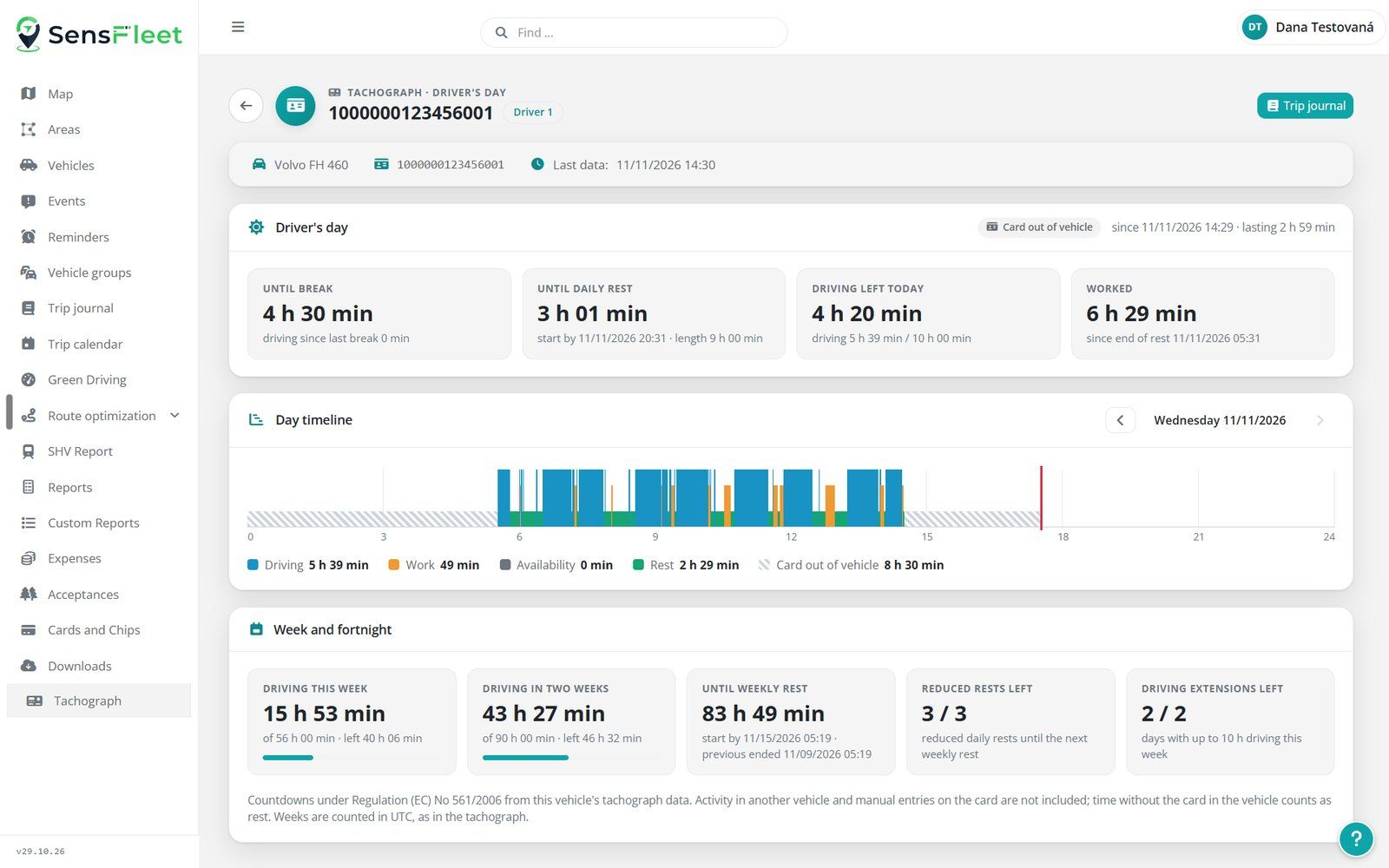
Driver's day: time until break and rest, day timeline and weekly limits. Illustrative data.
Infringement list
The app evaluates driving and rest times under Regulation 561/2006 and the AETR agreement. Infringements are listed by driver, vehicle and severity and can be exported to PDF.
GPS tracking and the electronic trip journal
In international transport you need an accurate overview of vehicle routes, border crossings and trip history. GPS tracking records all of this automatically and builds an electronic trip journal you can use for checks and internal records. The app matches the driver from the tachograph with their card and the trip journal.
Digital dispatching and route optimisation
Mandatory breaks and rest times affect transport planning. Digital dispatching helps assign jobs, optimise routes and make better use of the fleet. Dispatchers see where vehicles are and how trips are progressing, so they can make better use of drivers' working time.
Frequently asked questions
Does this apply to my van if I only drive within my own country?
No. Under the EU regulation, the new requirement for vans over 2.5 tonnes applies only to international transport and cabotage.
Do I need a tachograph if I only carry my own tools to a job abroad?
If you carry materials or tools for your own work within 100 km of your base and driving is not your main activity, the craftsman exemption may apply. Own-account transport not for hire or reward is also exempt for vehicles up to 3.5 tonnes. Check your specific case.
How often must tachograph data be downloaded?
Driver cards at least every 28 days, vehicle units every 90 days.
Be ready for a check
The new rules mean more administration and tighter transport planning. With a properly set up fleet management system, most of it runs automatically. You save time, reduce the risk of fines and are always ready for an inspection.
Not sure whether the new rules apply to your vehicles? Contact us. We will help you choose the right setup for GPS tracking, remote tachograph download and fleet management. Or try SensFleet free for 30 days.
Sources: Regulation (EC) No 561/2006 as amended by Regulation (EU) 2020/1054 (Articles 2, 3, 4, 6, 7, 8); Regulation (EU) No 165/2014 (Articles 8, 34, 36); Regulation (EU) No 581/2010; Czech Road Transport Act No 111/1994 Coll. This article is not legal advice. Updated 11 November 2026.
Join 30,000+ satisfied customers and save money with GPS vehicle tracking.
Or write to: sales@sensfleet.com
Have a question or want a free, no-obligation quote?


