
AI vehicle damage detection: how the new generation of GPS trackers spots an impact or a scratch before you do
2026-09-18
AI vehicle damage detection: how the new generation of GPS trackers spots an impact or a scratch before you do
Anyone who has dealt with damage to a company or rental vehicle knows how it goes: nobody knows exactly when or how the damage happened, drivers point the finger at one another, and the handover report is often written late – if at all. A new generation of GPS trackers changes that: they can detect damage automatically and prepare the documentation for resolving it straight away.
In the first part we explain how this kind of AI damage detection works; in the second we look at who it makes the most sense for and how you can get it through us.
Part 1: What AI damage detection is and how it works
It combines a battery-powered GPS tracker with artificial intelligence that evaluates the vehicle's motion data in real time. The model has been trained on data from more than 1 billion kilometres of real-world driving, so it can tell the difference between an ordinary jolt (mounting a kerb, harder braking) and genuine damage to the vehicle.
Being battery-powered means the tracker doesn't need a hard-wired power supply – the same principle we use for tracking trailers, equipment and assets.
How the whole process works
- Detection – the tracker registers an impact, scratch or dent based on motion and acceleration data.
- Driver prompt – the system asks the driver to photograph the damaged area with their mobile phone.
- Image recognition – the AI analyses the photo, then classifies and describes the damage.
- Automated report – the result is documentation that can be used straight away to settle the claim, with no reports to write up by hand.
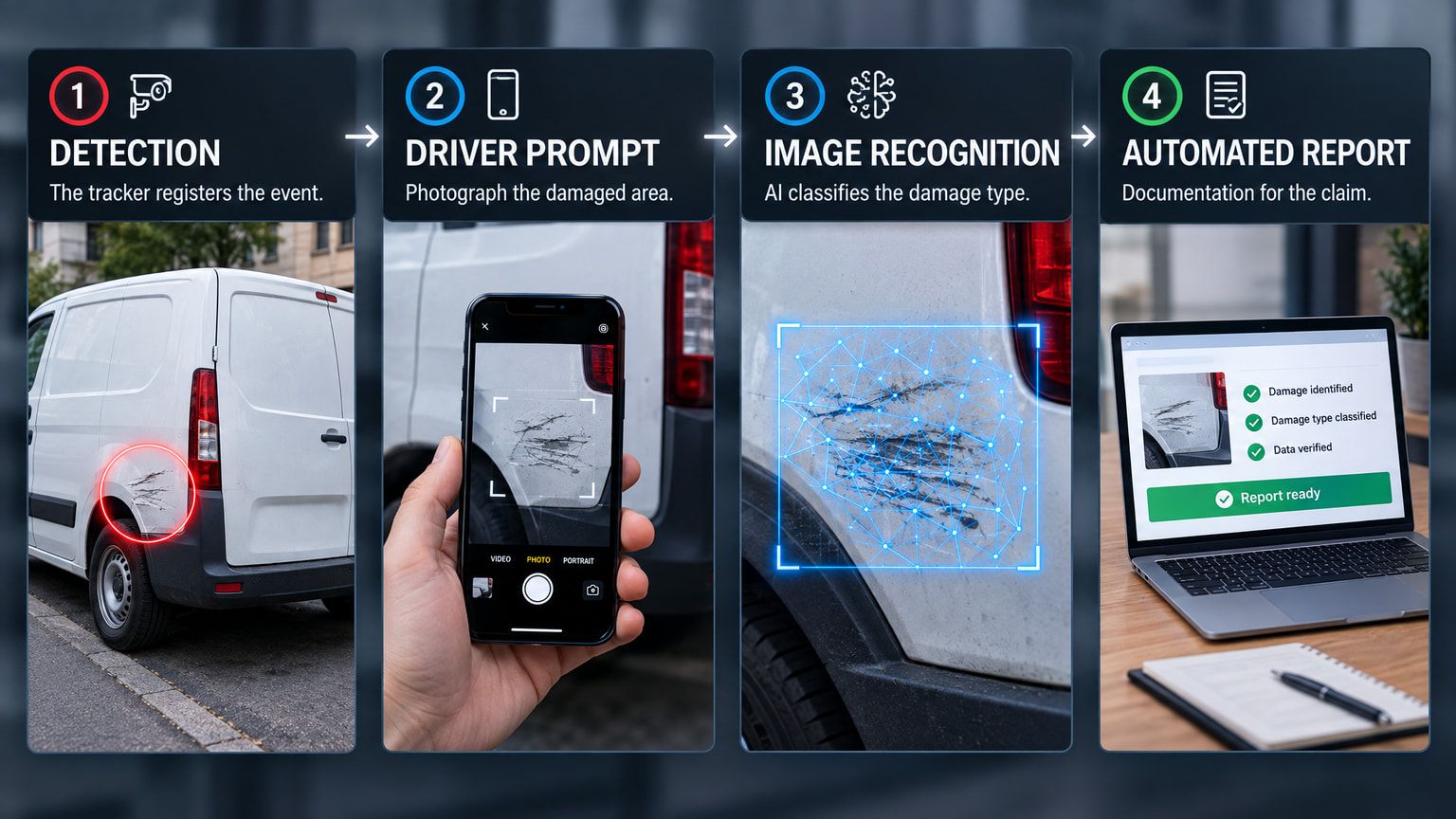
Illustrative diagram: from a recorded impact to finished documentation for settling the claim.
The principle of a system assessing a risky event by itself and backing it up with evidence is nothing new in the world of telematics. The same logic drives video telematics with AI risk detection, which we already offer today – the difference is that here it's about damage to the bodywork, not the driver's behaviour on the road.
The figures the manufacturer quotes for the technology
- 9 out of 10 damage incidents are fully documented as a result;
- up to 90% less manual administrative work involved in handling damage;
- 30–50% fewer damage incidents in the first place – though only over time, as more careful driving takes effect.
These are figures declared by the technology's manufacturer, not our own measurements.
Who benefits most
- Car rental companies – clarity about the vehicle's condition at every handover and return, with no arguing with the customer. Rental companies with rotating fleets already rely on us to keep track of their vehicles out on hire – you can read about their experience in our references.
- Delivery and last-mile fleets – a clear record of who damaged a vehicle and when, even when several drivers take turns across shifts. We cover this segment in our e-commerce section.
- Insurers and leasing companies – faster and more accurate claims settlement thanks to data and photo documentation available from the moment the incident occurs.
In short: the technology shifts damage handling from “who's to blame” to data that speaks for itself.
Part 2: What this new development means for you
This is exactly the kind of issue we deal with in fleets day in, day out – and we follow developments in the field closely. Automatic damage detection belongs to the same family of GPS trackers we routinely work with, so we know how to roll out a solution like this and connect it to the rest of your operations.
1. No more disputes at vehicle handover
Car rental companies and businesses whose drivers rotate between vehicles get a clear, dated record of the vehicle's condition – not one person's word against another's. The fact that GPS data can be used as evidence is also shown in our earlier article on how GPS reduces the risk of theft of rental companies' assets.
2. Faster claims settlement
The report, complete with the state of the damage and photo documentation, is generated automatically, so it can be passed straight to the insurer or into your internal claims process – with no weeks of waiting for paperwork.
3. Integration with the trip journal and reports you already use
It makes sense to keep data about the vehicle and its condition in the same place as your electronic trip journal and reports – not in yet another separate application.
4. Less damage simply because the system is there
According to the manufacturer, fleets find that drivers who know incidents are recorded automatically drive more carefully. That in turn is reflected in repair costs and insurance premiums. The same principle is at work in the driving style rating, which we looked at in our article on Green Driving.
5. We'll advise you whether, and in what form, it makes sense for you
Not every fleet needs it to the same extent – the benefit is greatest for car rental companies and last-mile fleets with a high turnover of vehicles and drivers. We'll gladly talk through what is realistic for your operations, and over what timescale.
Want to know how AI damage detection could help your fleet?
Get in touch – we'll go through your operations and tell you honestly where this kind of technology would save you the most work and money.
Join 30,000+ satisfied customers and save money with GPS vehicle tracking.
Or write to: obchod@satelitnisledovani.cz
Have a question or want a free, no-obligation quote?


