
How to choose a GPS fleet tracking system: what to ask before you sign a contract
2026-11-20
How to choose a GPS fleet tracking system: what to ask before you sign a contract
You'll see the GPS unit once, when it's installed. You'll use the application every day for years. That's why choosing GPS fleet tracking should start with the problems you need to solve, not with the price of the tracker. Here's what to ask a supplier, what makes up the price and how to try a solution before you commit for years.
1. What you need to solve
The most common mistake is choosing from a feature list. It works better to write down two or three things that cost you time or money today and look for a solution to those. Typical areas are:
- Trip records and tax: you want to stop logging trips by hand. Look for an electronic trip journal that fills itself in from GPS data.
- Fuel and costs: you suspect consumption doesn't match refuelling. Fuel consumption monitoring and cost records for each vehicle will help.
- Managing field work: your dispatcher needs to know who is closest to a job. The basis is real-time location and digital dispatching.
- Safety and driving style: you deal with accidents, wear and tear or fines. Focus on driver behaviour scoring.
- Freight transport: you need to watch driving times and download tachograph data without trips to the office.
- Machinery and assets: you track trailers, containers or construction machines that have no power supply of their own.
Think about what you'll need in two or three years, too. Ask whether you can add more features later without replacing the units.
2. The unit and installation
The type of unit determines what data you get from the vehicle. A good supplier recommends a unit based on the vehicle, not the catalogue.
- An OBD plug-in unit connects to the diagnostic port in a few minutes, without touching the wiring. For most cars and vans it's the quickest and cheapest option.
- A fixed installation with CAN data reads fuel level, odometer or engine speed, and the unit stays hidden. It suits trucks and any vehicle where you need accurate operating data.
- A battery-powered tracker works without any connection to the vehicle. It's designed for trailers, containers and other assets.
Also ask whether you can buy the unit or rent it, who installs it and what happens to it when you replace the vehicle. And check that it works on LTE networks. Older 2G-only units will stop working as 2G networks are switched off. You'll find an overview of unit types on the GPS units page.
3. What the application must do
The application is where you'll spend most of your time, so assess it most carefully. Ask for access and go through a normal working day with it. Check in particular:
- how often the location updates and whether the map is truly live;
- how long trip data is archived;
- whether the trip journal separates private and business trips and can be exported;
- which reports you get and whether they can be emailed to you automatically;
- whether the application alerts you to events, such as a vehicle entering an area or an upcoming inspection;
- whether there's a mobile app for you and for your drivers;
- how many people can use the application and whether you can limit what each of them sees;
- whether you can connect the data to your other systems through an API;
- whether an AI assistant can work with the data, for example through an MCP server. You can then ask about your fleet in plain language.
4. Trip records and tax
In many countries, a business that claims vehicle costs or VAT must be able to show which trips were made for business. A handwritten trip log takes drivers and accountants hours every month, and mistakes are easy to make. An electronic trip journal with GPS records routes, distances and times automatically. The driver only adds the purpose of the trip or marks it as private.
Check which format the trip journal exports to your accounting system and whether it contains everything your tax authority may ask for. The exact rules differ from country to country, so we recommend checking them with your tax adviser.
5. Employees and data protection
Tracking company vehicles is common and legitimate, but there are rules. Tell employees in advance what you track and why, and keep private trips separate from business ones. Ask the supplier where the data is stored, who can access it and how long it's kept. For the right set-up in your company, we recommend talking to a data protection specialist.
6. What makes up the price
The monthly fee is only part of the total cost. When comparing offers, look at every item:
- the unit: bought outright or rented as part of the service;
- installation: you can plug in an OBD unit yourself, a fixed installation is done by a technician;
- the monthly fee per vehicle: what exactly it includes and what costs extra;
- data archiving period: cheaper plans usually archive data for a shorter time;
- number of vehicles: larger fleets usually get a lower price per vehicle;
- contract term: how long you commit for and what happens when the term ends.
To give you an idea: our service starts at €6.00 a month per vehicle with 6 months of data archiving. Higher plans add real-time location and 24 months or more of data archiving. See pricing for the current overview. How much tracking can save a business is covered in How much can you save with GPS vehicle tracking.
What our monthly fee includes and what costs extra
To make offers easier to compare, here it is plainly:
- Included: the SIM card and data transfer, the application, data archiving according to your plan (Basic 6 months, Profi 24 months, Premium 24 months or more), data storage in the secure České Radiokomunikace data centre in Prague, access to the application over an encrypted HTTPS connection, and technical support.
- Charged separately: the GPS unit and its installation, and roaming data when vehicles travel abroad.
Basic or Profi?
On every plan, the unit records location in the same detail: by distance travelled, time, change of direction and whenever an input changes, such as the ignition being switched on. Routes and the trip journal are therefore complete even on the cheapest plan.
The plans differ in how quickly new data appears in the application:
- Basic is the entry-level, simplest version. Data appears in the application once every 5 minutes. It suits you if you want to get to know GPS tracking and don't need to follow vehicles live.
- Profi shows location in real time and archives data for 24 months. It's for businesses that manage work by location, such as dispatching or field service. Profi comes with a 24-month commitment. That's what lets us offer it at a reduced price; without the commitment, the price would be higher.
If you're not sure, start on Basic. You can move to Profi at any time during your contract by contacting your sales representative. In most cases you won't need to replace the unit.
7. Growth, support and your data
Ask how the solution will adapt as your business grows. With us, for example, you can move to a higher plan with the same unit, and we only switch on the features you need.
Support matters just as much. Check whether you'll be talking to a person who understands your business and how quickly they respond. Ask about service availability, too. Ours is 99.98%. And don't forget your data: how you'll get it out if you ever want to change supplier.
8. Try before you buy
A feature list on a website is no substitute for your own experience. Before you sign a contract, try the application yourself. The free demo is one click away, so you can see straight away how it works. If it convinces you, arrange a trial on a few of your own vehicles. Within a few weeks you'll know whether the solution does what you needed.
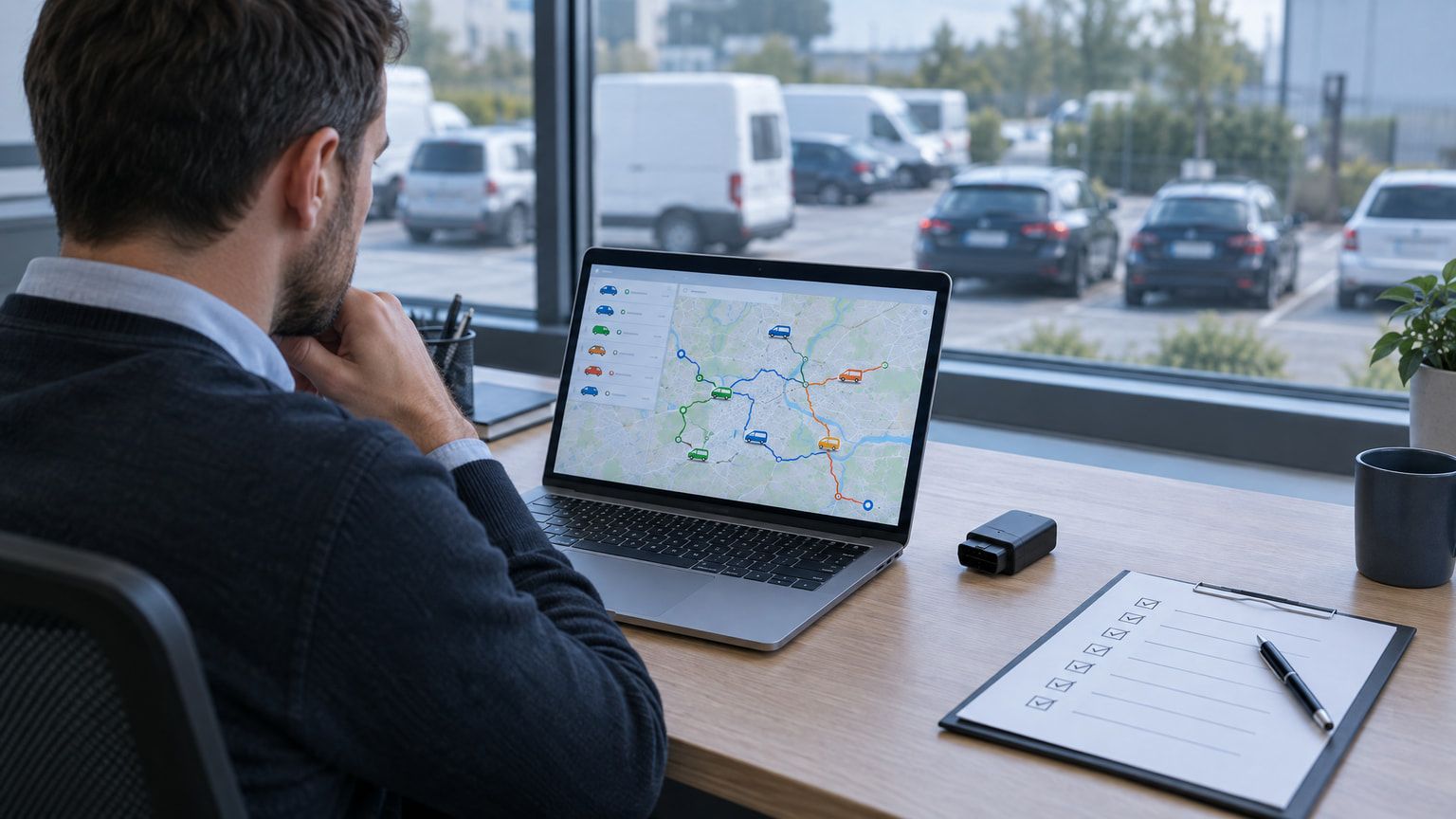
Illustrative image
Checklist: questions for your supplier
- Which unit do you recommend for our vehicles, and why?
- Can we buy the units as well as rent them?
- Who installs them and how long will the vehicle be off the road?
- Do the units work on LTE networks?
- How often does the location update in the application, and does the unit still record the full route?
- How long is data archived?
- How many people can use the application, and can we limit what each person sees?
- Does the trip journal separate private and business trips, and how do we export it to our accounting system?
- What exactly does the monthly fee include, what costs extra and what price do we get for our number of vehicles?
- Can we connect the data to our own systems or to an AI assistant?
- How long is the contract term?
- Can we add more features later without replacing the units?
- How do we get our data out if we decide to leave?
- How do we reach you when something doesn't work?
- Can we try the solution first?
Frequently asked questions
How long does it take to start using GPS fleet tracking?
With an OBD unit, it can be the next day. We send the unit by courier and you plug it in yourself in a few minutes. Fixed installations are scheduled by appointment.
Why don't you offer a tracker with no monthly fee?
A tracker with no monthly fee is a one-off purchase that shows a location on a map. That's usually not enough for a business. That's why we offer a GPS fleet tracking service, not just a tracker. The monthly fee covers the application, data archiving, the trip journal, fuel and cost overviews, and support when something doesn't work.
Do we have to replace units when moving to a higher plan?
Usually not. With us, the same unit can be moved to a higher plan. We'll tell you in advance whether that's possible, based on the type of unit.
Can we track machinery and trailers without their own power supply?
Yes. Battery-powered trackers are designed for this and last a long time without any connection to the vehicle. Find out more on the Trailers, equipment and assets page.
Not sure which option is right for you? We'll be happy to go through how your business works and propose a tailored solution.
Join 30,000+ satisfied customers and save money with GPS vehicle tracking.
Or write to: sales@sensfleet.com